Titelfoto: Christof Graf

Titelfoto: Christof Graf


engl. Version:
Photos: Prof. Dr. Christof Graf
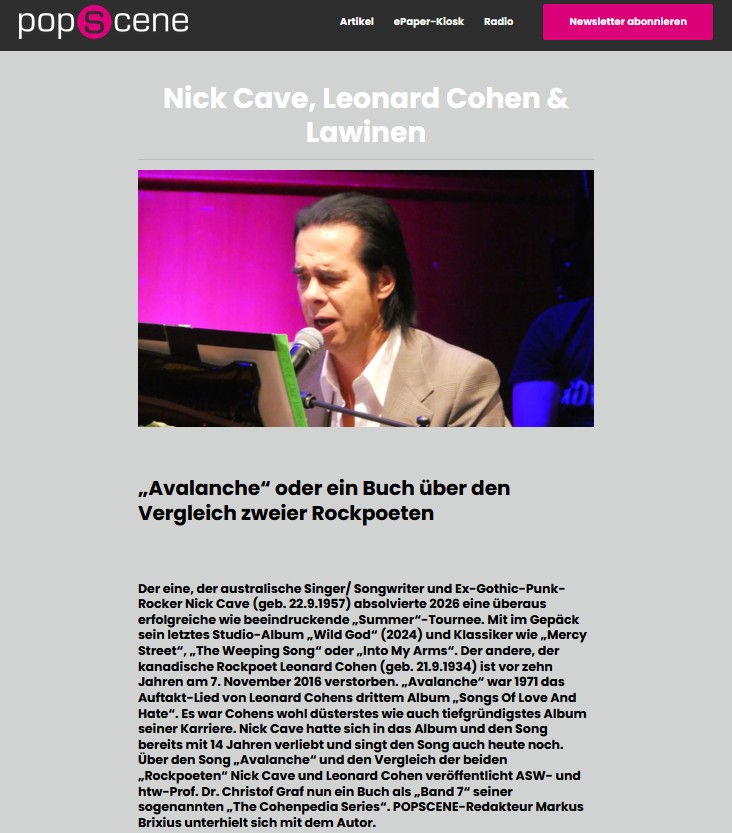
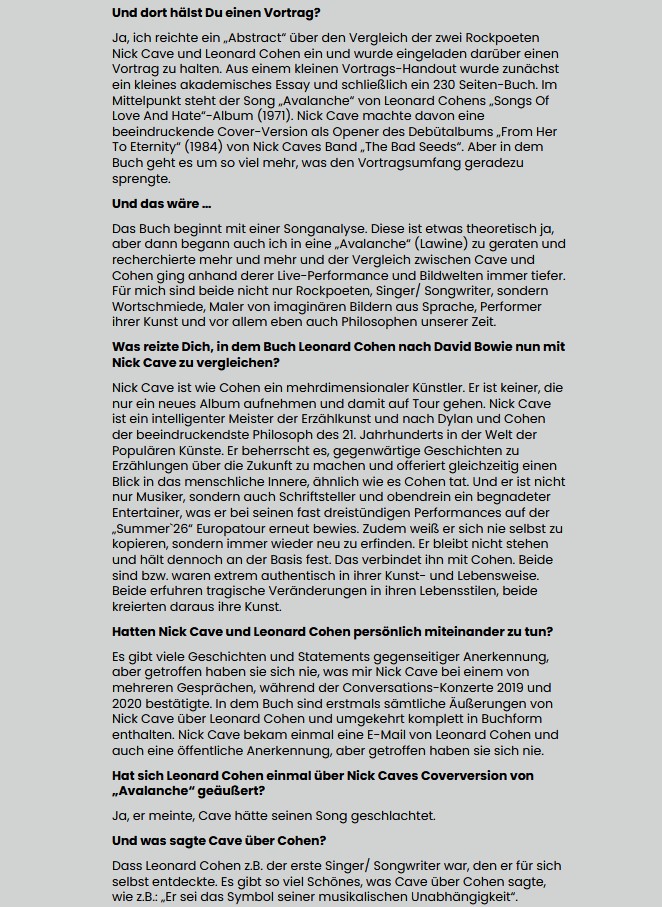
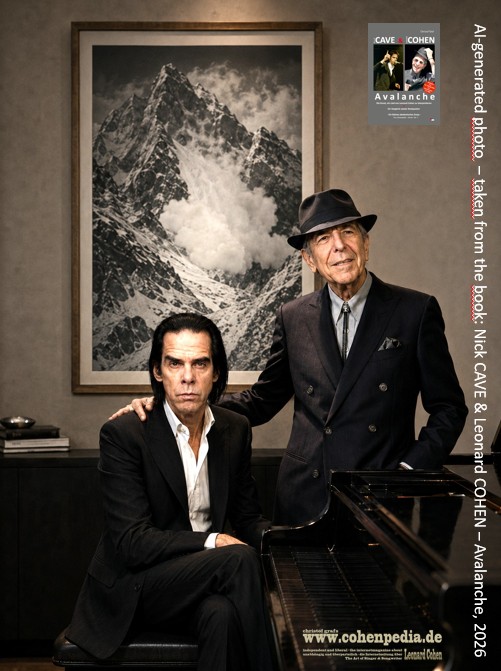
One, the Australian singer/songwriter and ex-gothic punk rocker Nick Cave (born 22.9.1957) completed an extremely successful and impressive „Summer“ tour in 2026. In his luggage was his last studio album „Wild God“ (2024) and classics such as „Mercy Street“, „The Weeping Song“ or „Into My Arms“. The other, the Canadian rock poet Leonard Cohen (born 21.9.1934) died ten years ago on November 7, 2016. „Avalanche“ was the opening song of Leonard Cohen’s third album „Songs Of Love And Hate“ in 1971. It was probably Cohen’s darkest as well as most profound album of his career. Nick Cave had already fallen in love with the album and the song at the age of 14 and still sings the song today. About the song „Avalanche“ and the comparison of the two „rock poets“ Nick Cave and Leonard Cohen, ASW and htw Prof. Dr. Christof Graf (University of Applied Sciences htw saar) now publishes a book as „Volume 7“ of his so-called „The Cohenpedia Series“. POPSCENE editor Markus Brixius talked to the author.
„Nick Cave & Leonard Cohen – Avalanche“ is already the seventh volume of „The Cohenpedia Series“. How many of them are still planned and how did the „book series“ come about in the first place?
Prof. Dr. Christof Graf: In 2016, the idea arose to write a kind of „Leonard Cohen Encyclopedia“. As a Leonard Cohen author and archivist for decades and since 1996 operator of the oldest bilingual Leonard Cohen website „cohenpedia.de“, I quickly realized after the two biographies I had written about Leonard Cohen in 1996 and 2010 that I had far too much material for just one volume of the encyclopedia. So I immediately published volumes 1 and 2, and all that, such as setlists of the tours or so-called „spoken words“ at concerts, came afterwards in volume 3. Then the idea arose to create a ten-volume „encyclopedia series“ from it. Each volume with a different thematic focus. Volume 4 is a kind of upgraded re-print version of my 1994 documentary of Leonard Cohen’s 1993 „The Future“ world tour with an extensive interview with Andrew Eldritch, who named his band „The Sisters Of Mercy“ after a song by Leonard Cohen.
And then?
Prof. Dr. Christof Graf: Then came the pandemic, the lock downs and the idea of continuing to rummage through the archive and work on more volumes. I wanted to represent a color palette of gray tones in Leonard Cohen’s work, which is also reflected in the primary colors of the respective volumes. Volume 1 was white, volume ten will be black, with a ten percent gradation of different shades of gray in between. Volume 5 is about the last albums of David Bowie and Leonard Cohen, who both unfortunately passed away in 2016, and in the same year their last album, which dealt with their own approaching demise. And volume 6 is a kind of mixture of a homage to the British prog rock band Marillion and a declaration of love to Leonard Cohen’s hometown of Montreal. I went there in search of clues and discovered about 60 locations that have to do with Leonard Cohen’s life. I visited his birthplace, his home, his bagel shop, talked to friends of Cohen in Montreal and a kind of „Leonard Cohen Montreal City Guide“ was created, of which there is also a Google Maps map and also Marillion’s connection to Leonard Cohen.
And what is behind the seventh volume, with the promising title „Nick Cave & Leonard Cohen – Avalanche“?
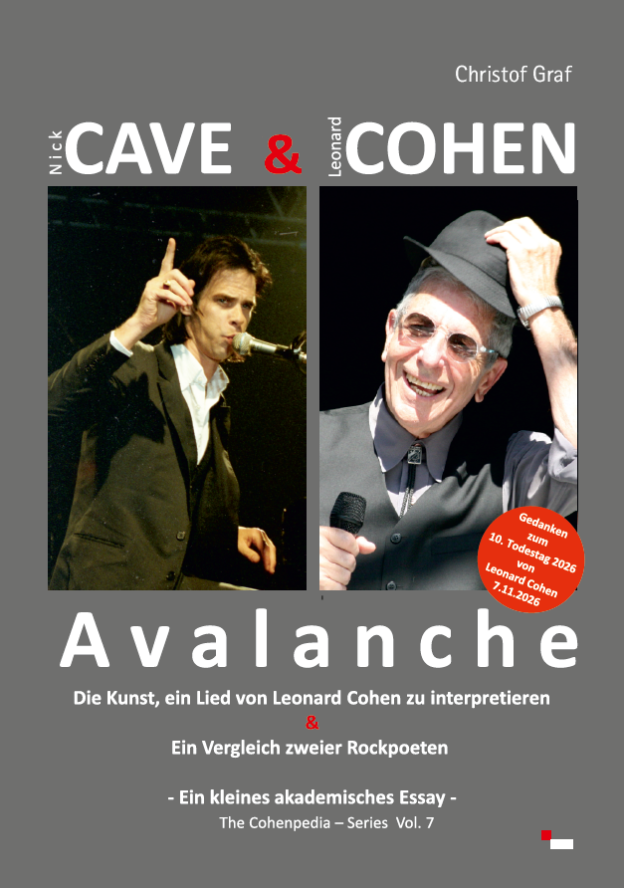
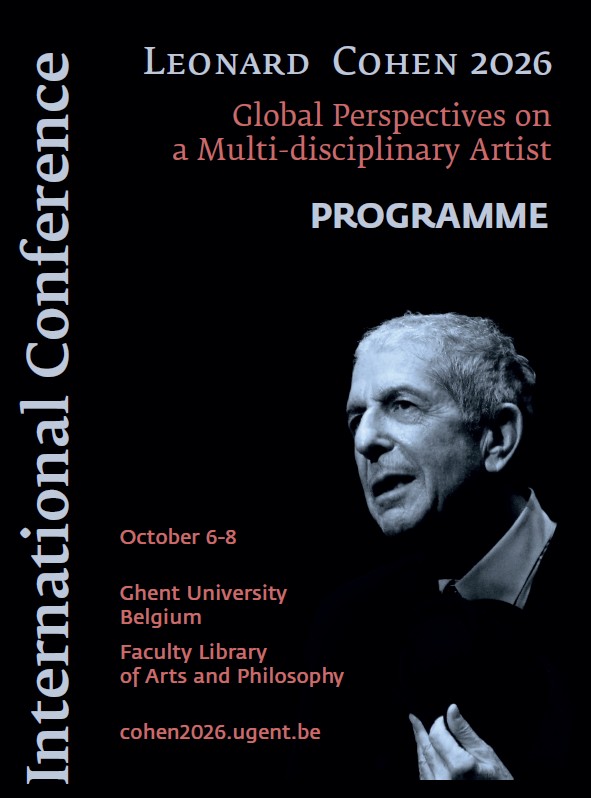
Prof. Dr. Christof Graf: I’m always looking for new approaches to deal with Leonard Cohen’s work. And after Bob Dylan and Leonard Cohen, Nick Cave is, in my opinion, the No. 3 of the great pop writers of our time. I’ve always wanted to write a book about Nick Cave. But there are already too many and in the end it would only be Nick Cave himself who could write the best book about himself. The idea for the visit came to me when I started writing a text for the „Leonard Cohen – Global Perspectives on a multi-disciplinary Artist“ event, an international conference on multi-disciplinary art regarding Leonard Cohen at the University of Ghent/ Belgium, which will take place from October 6-8, 2026.
And there you give a lecture?
Prof. Dr. Christof Graf: Yes, I submitted an „abstract“ about the comparison of the two rock poets Nick Cave and Leonard Cohen and was invited to give a lecture about it. A small lecture handout first became a small academic essay and finally a 230-page book. The focus is on the song „Avalanche“ from Leonard Cohen’s „Songs Of Love And Hate“ album (1971). Nick Cave made an impressive cover version of it as the opener of the debut album „From Her To Eternity“ (1984) by Nick Cave’s band „The Bad Seeds“. But the book is about so much more, which almost exceeded the scope of the lecture.
And that would be …
Prof. Dr. Christof Graf: The book begins with a song analysis. This is a bit theoretical, yes, but then I also started to get into an „avalanche“ and researched more and more and the comparison between Cave and Cohen went deeper and deeper based on their live performance and visual worlds. For me, both are not only rock poets, singers/songwriters, but wordsmiths, painters of imaginary images from language, performers of their art and, above all, philosophers of our time.
What appealed to you to compare Leonard Cohen with Nick Cave in the book after David Bowie?
Prof. Dr. Christof Graf: Nick Cave, like Cohen, is a multidimensional artist. He is not someone who just records a new album and goes on tour with it. Nick Cave is an intelligent master of storytelling and, after Dylan and Cohen, the most impressive philosopher of the 21st century in the world of popular arts. He masters how to turn current stories into narratives about the future and at the same time offers a look into the human interior, similar to what Cohen did. And he is not only a musician, but also a writer and a gifted entertainer on top of that, which he proved again during his almost three-hour performances on the „Summer’26“ European tour. In addition, he never knows how to copy himself, but to reinvent himself again and again. He does not stand still and yet holds on to the basics. This connects him with Cohen. Both are or were extremely authentic in their art and way of life. Both experienced tragic changes in their lifestyles, both created their art from them.
Did Nick Cave and Leonard Cohen have personal dealings with each other?
Prof. Dr. Christof Graf: There are many stories and statements of mutual recognition, but they never met, which Nick Cave confirmed to me during one of several conversations during the Conversations concerts in 2019 and 2020. For the first time, the book contains all of Nick Cave’s statements about Leonard Cohen and vice versa in book form. Nick Cave once received an email from Leonard Cohen and also a public recognition, but they never met.
Has Leonard Cohen ever commented on Nick Cave’s cover version of „Avalanche“?
Prof. Dr. Christof Graf: Yes, he said Cave had slaughtered his song.
And what did Cave say about Cohen?
Prof. Dr. Christof Graf: That Leonard Cohen, for example, was the first singer/songwriter he discovered for himself. There are so many beautiful things that Cave said about Cohen, such as: „He is the symbol of his musical independence“.
What is the song „Avalanche“ about?
Prof. Dr. Christof Graf: It is a song that allows for diverse, profound, spiritual and psychological interpretations. It is a song full of images, a song as a metaphor for so many things, such as interpersonal relationships. It is about a difficult situation that has to be overcome, about the search for redemption, hopelessness. Some also see the song as a song about Mother Nature. In the end, Cohen cultivates in the song the melancholy that has always been said of him and to which Cave is also attracted. And the – also partly biblical – imagery that he uses is similar to those that Cave later uses in his own songs. But there are many other parallels between Cave and Cohen, such as their preferences for the enigmatic, the elegiac and ultimately their relationship to their audience.
Are there any other Cohen songs besides „Avalanche“ that Cave has covered?
Prof. Dr. Christof Graf: Yes, actually just under ten, such as „Tower Of Song“, „Famous Blue Raincoat“, „Suzanne“. I also go into this in detail in my Leonard Cohen podcast („Be Kind- Der Leonard Cohen Podcast“), which I produce with the singer-songwriter Rolf Ableiter (fieldcommander-c.de).
Has Cohen ever covered a Cave song?
Prof. Dr. Christof Graf: No
You said that there are already so many books about Nick Cave. What makes yours different?
Prof. Dr. Christof Graf: In addition to the song, performance and dialogue analyses, it also contains a biographical timeline with complete discography of both artists as well as over 100 previously unpublished photos of Cave and Cohen.
BOOK – INFO: „Nick Cave & Leonard Cohen – Avalanche“ – Comparison of Two Rock Poets – The Cohenpedia Series Vol. 7, COD-Verlag, Saarbrücken, 2026; ISBN 978-3-945329-22-1; approx., 230 pages, 100 photos (b/w); Euro: 19.90.-Info at: www.cohenpedia.de or info@cod.de.

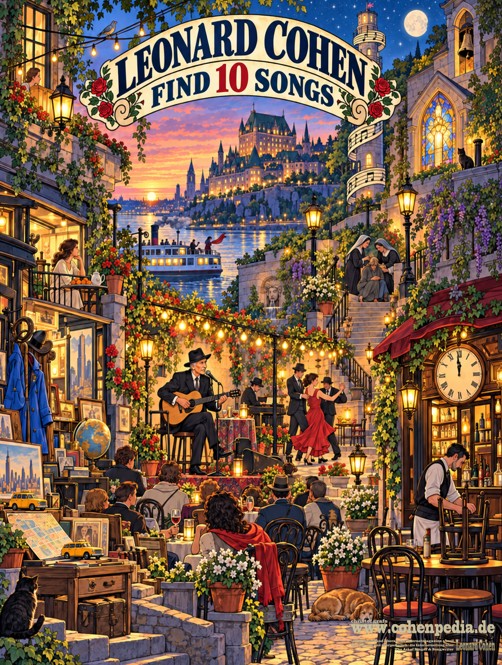
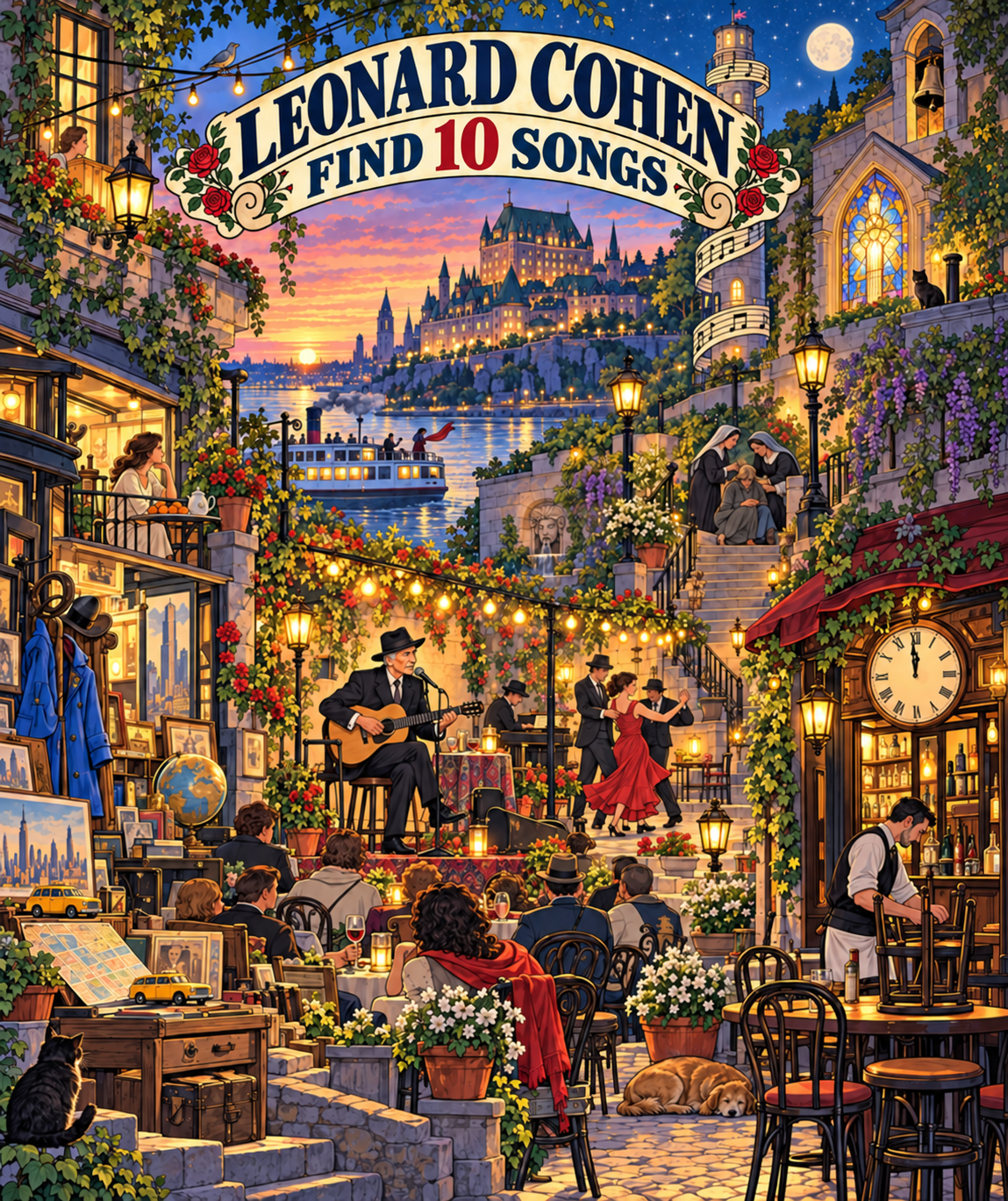
GIBT ES DEN BEGRIFF „WIMMELBUCH“ eigentlich auch im Englischen? Ja, im Englischen wird das deutsche Wort inzwischen direkt als Lehnwort „wimmelbook“ genutzt. Große US-Verlage vertreiben diese Buchreihe mittlerweile gezielt unter Marken wie „My Big Wimmelbook“.
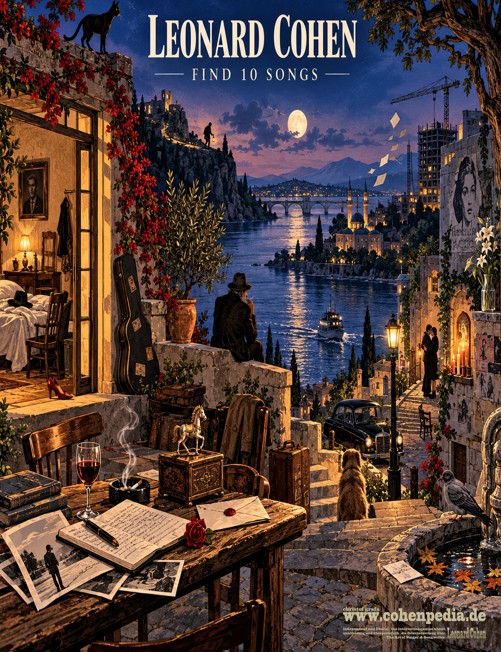
Bei diesem Bild sind die Hinweise absichtlich weniger eindeutig. Gedacht waren zehn andere Cohen-Songs als in den vorherigen Rätseln:
Ein paar Elemente sind bewusst falsche Fährten – etwa Taube, Hund, Baustellenkran und einzelne religiöse Motive. Dadurch sollte man nicht einfach zehn Gegenstände suchen, die direkt Songtitel abbilden.
Bei diesem Bild ist mir allerdings ein Designfehler unterlaufen: „The Guests“ taucht in meiner ursprünglichen Symbolidee doppelt auf. Die sauberere Zehnerlösung ist daher die obige Liste mit „Take This Longing“ als Nr. 9.
In this image, the clues are intentionally less explicit. Ten different Cohen songs—distinct from those in previous puzzles—were intended here:

    Take This Waltz – the small horse on the music box and the romantic, old-fashioned setting evoke a waltz without showing a dancing couple.
    Chelsea Hotel #2 – the abandoned room on the left, the unmade bed, the hat, and the single red shoe speak of a past encounter rather than the hotel itself.
    The Guests – the various suitcases and pieces of luggage in the image point to people who have arrived or are about to leave.
    Treaty – the sealed letter on the table represents an agreement that has been written, concluded, or perhaps broken.
    Hey, That’s No Way to Say Goodbye – the waiting suitcases, the car, and the man gazing alone across the water combine to create a scene of farewell.
    Seems So Long Ago, Nancy – the old black-and-white photographs and the portrait of a woman on the wall feel like memories of someone from the distant past.
    If It Be Your Will – on the right, there is a small, almost private shrine with candles; the clue lies more in the attitude of devotion and anticipation than in any specific object.
    Light as the Breeze – the loose sheets of paper carried by the wind high above the city serve as the indirect clue.
    "The Guests" would have been an obvious duplicate—so the actual ninth song is *Take This Longing*: a rose, an unopened letter, an empty chair, and the waiting man combine to paint a picture of unfulfilled longing.
    Night Comes On – the clue here is the transition between the last light of evening, the onset of night, and the moon over the city—not the moon alone.

A few elements are deliberate red herrings—such as the dove, the dog, the construction crane, and certain religious motifs. This means you shouldn't simply look for ten objects that directly represent song titles.

However, I made a design error with this image: "The Guests" appears twice in my original concept for the symbols. The cleaner solution involving ten items is therefore the list above, with "Take This Longing" as number 9.
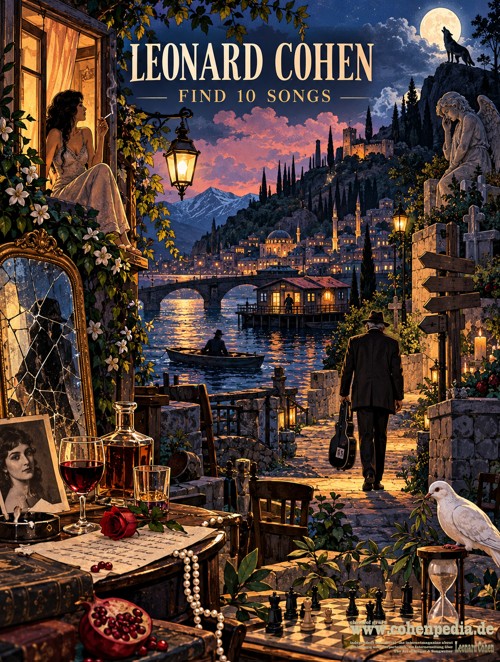
Im dritten Bild habe ich die Hinweise bewusst deutlich indirekter angelegt. Gemeint sind diese zehn Leonard-Cohen-Songs:
Einige Dinge – etwa Taube, Schachbrett, Wein, Granatapfel oder Wolf – sind absichtlich zusätzliche „falsche Fährten“. Dadurch soll man nicht jedes auffällige Objekt automatisch 1:1 mit einem Songtitel verbinden können.
In the third image, I deliberately made the clues much more indirect. The ten Leonard Cohen songs in question are:

    Avalanche – the rugged, partly snow-covered mountains in the background.
    The Stranger Song – the solitary man with a hat and guitar case, walking away from the viewer.
    In My Secret Life – the woman in the top left, withdrawn by the illuminated window.
    The Future – the hourglass in the bottom right, hinting at the passage of time and what is to come.
    Anthem – the cracked mirror on the left; an allusion to Cohen’s famous motif of the "crack" through which the light gets in.
    Waiting for the Miracle – the pensive angel in the cemetery and the almost expectant atmosphere of the night.
    A Thousand Kisses Deep – the portrait of an elderly woman, the pearls, the letter, and the rose, serving as reminders of a long-past love.
    The Partisan – the solitary figure on the move, the signposts, the fortified town, and the somber landscape evoke themes of flight, resistance, and displacement.
    You Want It Darker – night, candles, the cemetery, and the overall dark, sacred atmosphere combine to form the clue.
    Going Home – the older man walking alone down a path with his luggage, moving away from the scene and seemingly toward a final destination.

Certain elements—such as the dove, chessboard, wine, pomegranate, or wolf—are intentional "red herrings." This ensures that one cannot automatically link every conspicuous object directly to a specific song title.