Dusseldorf, Germany
Mitsubishi Electric Hall
October 27, 2026
Review by Christof Graf – Photos by Christof Graf
Die Leichtigkeit der Beständigkeit. Für die einen und dabei wohl auch für die meisten, ist das erste Konzert eines neuen Tourneeabschnitts von Bob Dylan zugleich auch das letzte dieser Tournee, weil sie eben nur ein einziges Konzert besuchen. Für andere ist vielleicht irgendein anderes oder aber auch das letzte Konzert eines Tourneeabschnitts das erste und zugleich das letzte. Andere besuchen gar mehrere Konzerte und können Konzerte vergleichen. Egal, zu welcher Besuchergruppe man gehört, man hat zumeist die Hoffnung, dass auch bei dem Konzert, das man gerade besucht, jene Lieder zu hören sind, auf die man sich besonders freut oder jene besonderen Lieder und Interpretationen zu hören sind, die z.B. schon vorab für Diskussionen in den sozialen Medien gesorgt haben. Mein Tourneeeinstieg 2026 war in Düsseldorf. Ein wenig war ich auf jene neidisch, die Dylan schon beim Tourneeauftakt seiner nun nicht mehr „Rough And Rowdy Ways Tour“, sondern „Lights of Autumn“-Tour betitelten Konzertreihe in Oslo/ Norwegen erleben konnten. Dort präsentierte Dylan eine radikal abgespeckte Version des „Tangeld Up In Blue“-Klassikers von 1975 – mit zwei völlig neuen Strophen. Dazu gab es in Oslo überraschende Coverversionen von Randy Newmans „Louisiana 1927“ und Guy Clarks „Dublin Blues“. Und erstmals seit 2005 spielte Dylan in Oslo auch wieder „Crash on the Levee (Down in the Flood)“. Außerdem gab es zur Überraschung aller einen neuen Gitarristen, dessen Namen man erst am Tag darauf in den sozialen Medien zu lesen bekam: Mike Seal an der elektrischen Gitarre.
Ob das alles auch in Düsseldorf zu erleben sein würde, ist wie alles bei Dylan ungewiss. Mit 19 Songs fing er in Oslo an, schon tags darauf waren es nur noch 18 und an den drei Konzertabenden zuvor in Horsens (Denmark), Flensburg und Bremen (Germany) war das Set jeweils auf 17 Songs zusammengeschrumpft.
Ob er in Düsseldorf sein knapp 90 minütiges Set mit „Watching The River Flow“ und „Love Sick“ beginnen würde, wie er es zwei Tage zuvor in Bremen tat? Ob er mit „To Be Alone With You“ und danach eben mit irgendetwas weitermachen würde oder ob er halt irgendetwas ganz anders machen würde, bis er seinen Flow findet, waren alles Fragen, die man schließlich erst mit den ersten Klängen des ersten Songs beantwortet bekommt, sofern man überhaupt solche Fragen stellt oder nach solchen Antworten sucht. Das Gros des Publikums, will eh nur den – mittlerweile 85 jährigen – „Meister“ vielleicht dann doch noch ein letztes Mal live erleben, egal, was er da spielt.
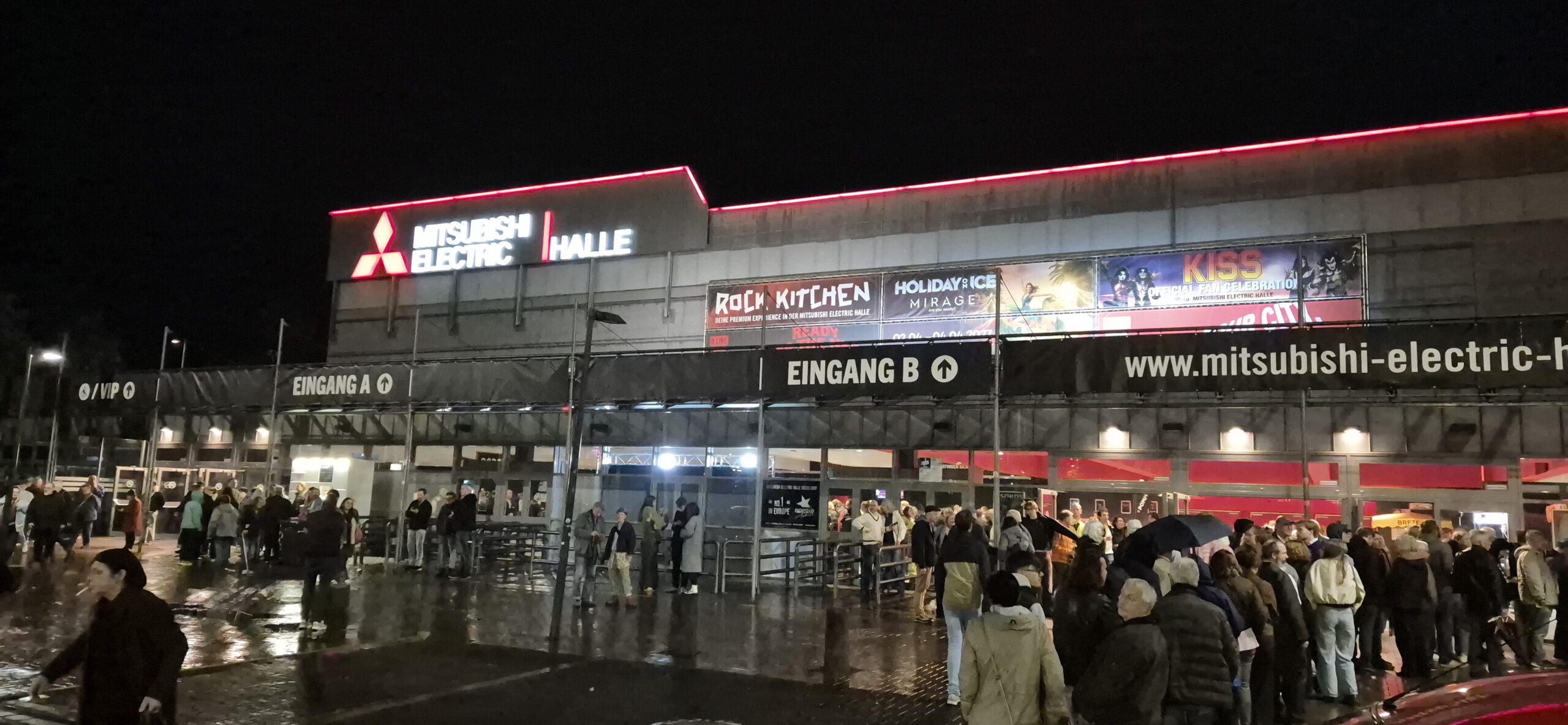
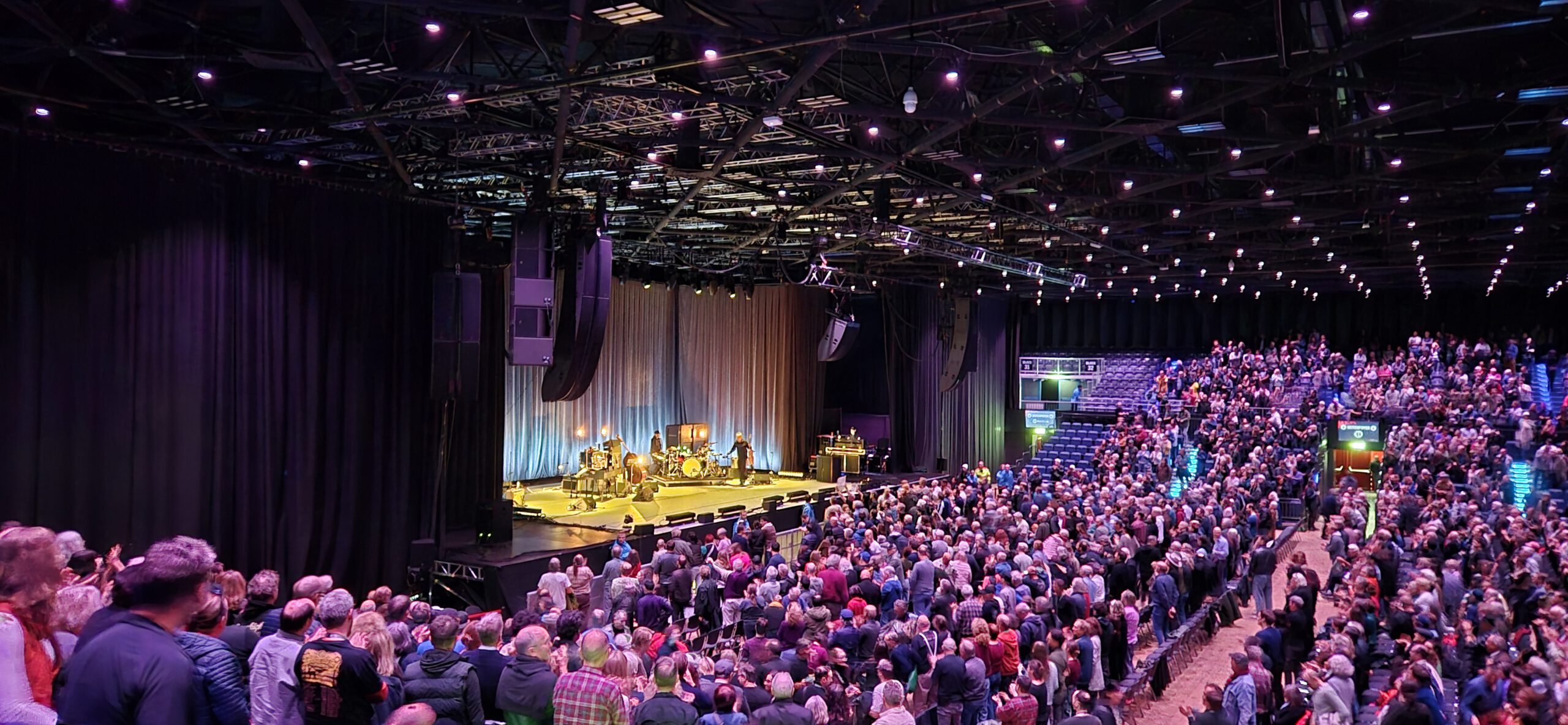
Und das war dann wohl auch der Grund, warum die aufgrund eines Sponsorenwechsels seit 2011 nunmehr von einst „Philips-Halle“ in „Mitsubishi Electric Halle“ umetikettierte Konzert-Location mit etwa 4000 Zuschauern zu etwa 95 % ausverkauft war.
Die meisten davon standen wie ich auch, zuvor entweder im Stau oder im Regen. Dieses Mal benötigte ich für die 312 Kilometer von meinem Zuhause im Südwesten bis Düsseldorf über fünf Stunden. Gegen 19.30 bekam ich tatsächlich noch einen der wenigen letzten offiziellen Parkplätze vor der Halle. Kaum angekommen, gab es Starkregen. Sozialisierung mit über die Jahre liebgewonnenen Dylanologen/ innen und Dylanianer- und innen wurde verkürzt und nach drinnen verlegt.
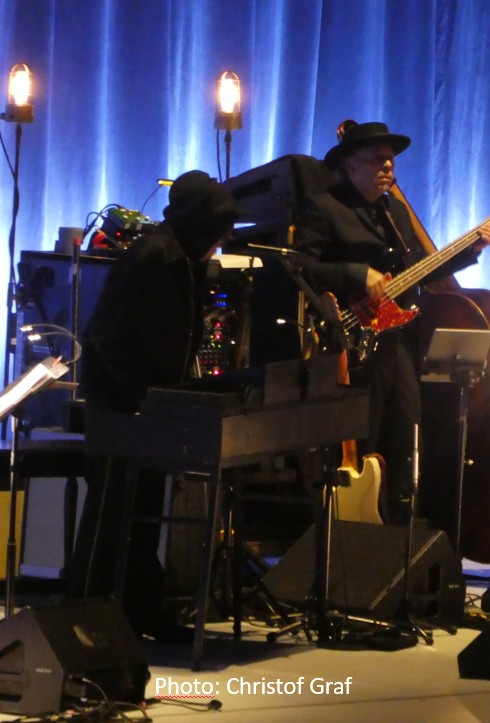
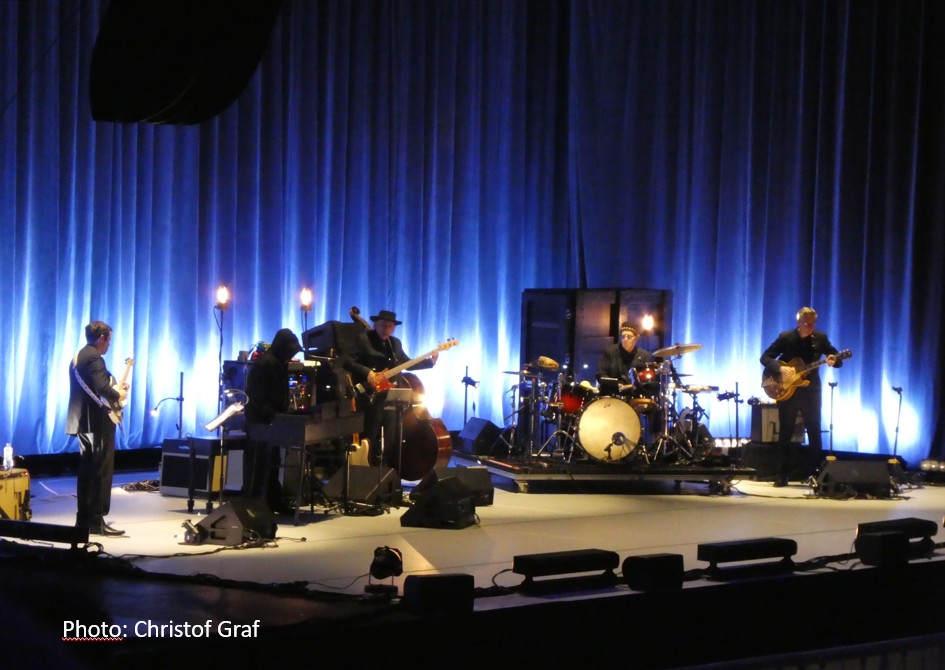
Auch der Gang zum Merch-Stand fand verkürzt statt. Das rechtzeitige Einnehmen des Platzes hat immer Vorrang. Punkt 20.00 Uhr ging das Licht aus? Nein! Ging es nicht! Es blieb an! Ich habe noch nie ein so hell erleuchtetes Dylan-Konzert erlebt. Ja, vor 30 Jahren wurde hin und wieder die Zugabe bei Saallicht gespielt. Heutzutage gibt es kaum Zugaben und alles ist zumeist Dunkel, vom zarten Licht der Smartphone-Displays ganz zu schweigen. Die gibt es wegen dem Smartphone-Verbot auch schon lange (seit 2021) nicht mehr. Ich weiß nicht, wie es bei den vorangegangenen Konzerten war und wie es bei den noch folgenden sein wird: Aber in Düsseldorf wurde das Saallicht nur leicht gedimmt. Gefühlt war es für Dylan-Verhältnisse taghell. Punkt 20.00 Uhr ging also nicht das Saallicht aus. Von rechts erklomm Dylans Band die Bühne, links schlich sich ein Mann mit Hoodie hinter sein Keyboard. Ja, der Mann mit schwarzen Schuhen, schwarzer Hose und schwarzem Hoodie, von dem höchsten die vorderen Reihen mal eine Nasenspitze aus dem Hoodie ragen sahen, soll Bob Dylan sein? Er ist es, was man bei den ersten Zeilen vom Opener „Watching The River Flow“ nachweislich zu hören bekommt.
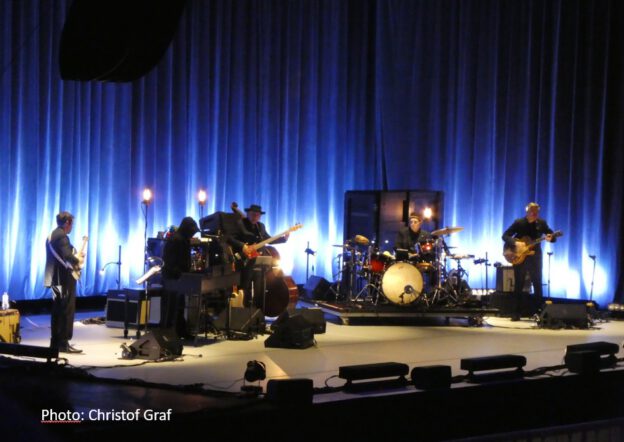
Der Bühnenboden ist hellgrau. Farbwechsel im Bühnenhintergrund gibt es wie auf der „RARW“-Tour nicht mehr. Der Bühnenvorhang bleibt vom hinteren Boden aus angestrahlt in einem dezentem Kobaltblau eingetaucht. Links auf der Bühne steht Joel Paterson, rechts außen der im Oktober 2026 neu zur Tour gestoßene „Mystery-Gitarrist“ Mike Seal. In der Mitte der Bühne sitzt oder steht Bob Dylan an seinem Keyboard, während Bassist Tony Garnier und Schlagzeuger Anton Fig (aus Dylans Perspektive links) die Rhythmussektion im Hintergrund bilden.
Dylan beweist an diesem Abend in Düsseldorf 2026 einmal mehr, dass sein umfangreicher Liedkatalog für ihn kein abgeschlossenes Kapitel ist. Er bildet vielmehr ein musikalisches Reservoir, aus dem er immer neue Ausdrucksformen entwickelt. Er gibt alten Liedern neue Perspektiven und bedient sich in Düsseldorf Lieder aus sieben Jahrzehnten künstlerischen Schaffens, wenn er einen Zeitbogen von 1964 („It Aint Me, Baby“) bis 2020 (vier „Rough And Rowdy Ways“-Songs) schlägt.
Bob Dylan hat nie sonderlich viel Interesse daran gezeigt, den Erwartungen anderer zu entsprechen. Das gilt für seine Karriere ebenso wie für seine Konzerte. Wer seine bekanntesten Songs in jenen Fassungen hören möchte, die vor Jahrzehnten auf Schallplatte erschienen, wird bei ihm nicht unbedingt fündig. Doch gerade diese Unberechenbarkeit ist längst zu einem wesentlichen Bestandteil seiner künstlerischen Identität geworden.
Auch das Düsseldorfer Konzert im Rahmen seiner „Lights of Autumn“-Tour folgte dieser Philosophie. Gemeinsam mit seiner vierköpfigen Band präsentierte Dylan 18 Songs aus unterschiedlichen Phasen seines Schaffens.

Ein solcher zeitlicher Bogen könnte leicht zu einem Rückblick auf die eigene Karriere geraten. Dylan jedoch verzichtet darauf, seine Vergangenheit in chronologischer Ordnung auszustellen. Stattdessen bringt er Stücke unterschiedlicher Entstehungszeiten in einen gemeinsamen musikalischen Zusammenhang. Blues, Country, Jazz und Elemente traditioneller amerikanischer Unterhaltungsmusik bilden dabei das stilistische Fundament. Von den neun der zehn Songs aus dem letzten Album „Rough and Rowdy Ways“, die er seit 2021 bis 2025 regelmäßig live darbot, sind „in concert“ nur noch vier übriggeblieben. Dafür spielte an diesem Abend vor allem ein Album eine bemerkenswerte Rolle: „Time Out of Mind“ aus dem Jahr 1997.
Im Mittelpunkt stehen dabei weniger die Wiedererkennbarkeit einzelner Melodien als die Frage, was sich mit diesen Songs heute noch anfangen lässt. Nicht jedes Stück wird dabei grundlegend verändert, doch viele erhalten durch neue Tempi („Trying To Get To Heaven“) , Instrumentierungen („Early Roman Kings“) oder eine andere gesangliche Phrasierung („When I Paint My Masterpiece“) eine eigenständige Gestalt. Die vierköpfige Band-Besetzung mit zwei Gitarristen, einem Schlagzeuger und einem Bassisten ermöglicht Arrangements, die sich zwischen traditionellen Bluesmustern, zurückhaltenden Balladen und rhythmisch akzentuierten Passagen bewegen.
Auffällig war wie gesagt die starke Präsenz des Albums „Time Out of Mind“. Mit „Love Sick“, „Tryin‘ to Get to Heaven“, „Not Dark Yet“ und „Million Miles“ standen gleich vier seiner Kompositionen auf dem Programm. Als das Album 1997 erschien, wurde es weithin als bedeutender neuer Abschnitt in Dylans Karriere wahrgenommen. Die Texte kreisen häufig um Einsamkeit, enttäuschte Hoffnungen, Vergänglichkeit und die Suche nach Orientierung. Produzent Daniel Lanois hatte diesen Liedern damals eine dichte, atmosphärische Klanggestaltung verliehen. Fast dreißig Jahre später nähert sich Dylan 2026 in Düsseldorf diesem Material noch einmal aus einer anderen Lebensphase. Die Songs bleiben dieselben, doch die Persönlichkeit, die sie interpretiert, hat weitere Jahrzehnte an Erfahrungen gesammelt. Das verleiht insbesondere den nachdenklichen Kompositionen eine zusätzliche Ebene. Wo einst ein Künstler Ende fünfzig über Verlust, Zeit und Endlichkeit nachdachte, singt nun ein 85-Jähriger dieselben Worte. Die biografische Distanz zwischen Entstehung und heutiger Interpretation gehört unweigerlich zum Hörerlebnis. Viele im Publikum scheinen das ähnlich zu empfinden. Es gibt oft Szenen-Applaus.
Am deutlichsten zeigte sich das bei „Not Dark Yet“. Das Berücksichtigen dieses Songs führte wohl dazu, dass „Girl From The North Country“ wie tags zuvor in Bremen nicht gespielt wurde. Sieben Jahre lang hatte Dylan „Not Dark Yet“ nicht mehr auf einer Konzertbühne gespielt. In Düsseldorf nahm er das Lied erstmals seit November 2019 wieder in sein Programm auf, aber es klang völlig anders als man es in Erinnerung hatte. Langsam, schwer und spürbar melancholisch klang es 1997. 2026 in Düsseldorf wurde es zu einer kürzeren, rhythmisch beweglicheren Version. Sogar ein zarter Reggae-Klang nimmt der Musik etwas von ihrer ursprünglichen Schwere. Die Düsterkeit der Worte von 1997 bleibt, deren Wirkung hat sich 2026 verändert. Noch bemerkenswerter war allerdings, dass Dylan den Song nicht einfach in seiner vertrauten musikalischen Gestalt wieder aufgriff. Das Arrangement erhielt eine neue rhythmische Ausrichtung und entfernte sich damit deutlich von der getragenen Atmosphäre der Studioaufnahme. „Not Dark Yet“ beschäftigt sich mit der Erfahrung, dass Zeit und Lebenskräfte nicht unbegrenzt zur Verfügung stehen. Im Alter seines Interpreten drängt sich eine biografische Lesart beinahe auf. Doch Dylan scheint gerade diese naheliegende Deutung nicht ungebrochen bestätigen zu wollen, zu dem wirkt er an diesem Abend sehr aufgeräumt und durchaus stabil.
Die Musik aber verändert den Blick auf den Text. Was ursprünglich vor allem als Ausdruck tiefer Erschöpfung erschien, gewinnt in der neuen Fassung eine andere Bewegung. Die Auseinandersetzung mit der Endlichkeit bleibt aber auch bei „Black Rider“ bestehen, wird aber nicht ausschließlich von Schwermut bestimmt.
Neben den vier Stücken aus „Time Out of Mind“ bildeten Songs aus „Rough and Rowdy Ways“ einen weiteren Schwerpunkt: „Crossing the Rubicon“, „Black Rider“, „I’ve Made Up My Mind to Give Myself to You“ und „Goodbye Jimmy Reed“ standen für eine Schaffensphase, in der Dylan amerikanische Musiktraditionen zunehmend mit erzählerischen, philosophischen und historischen Motiven verbindet.
Auch das 2012 erschienene Album „Tempest“ war mit „Early Roman Kings“ und „Soon After Midnight“ vertreten.
Dazwischen fanden sich ältere Kompositionen wie „Tangled Up in Blue“, „When I Paint My Masterpiece“ und „Under the Red Sky“. Ganz Ehrlich? Ob es sich bei der (neuen) „Tangled Up in Blue“-Version in Düsseldorf um die mit den zwei neuen Strophen handelt, die er in Oslo gespielt hatte, hab ich nicht herausgehört.
Mit „I Can Tell“ und die von Don Robertson geschriebene Ballade „Can’t Seem to Say Goodbye“, die unter anderem durch Jerry Lee Lewis bekannt wurde, offerierte Dylan zudem noch zwei Fremdkompositionen.
Mit einem geradezu hymnischen Ruhe entstehen lassenden „I’ve Made Up My Mind to Give Myself to You“ als drittletzter Song nach „Under The Red Sky” gibt es noch eine der schönsten Balladen des „Rough and Rowdy Ways”-Albums.
Danach bringt das rock`n`roll-hafte „Goodbye Jimmy Reed“ noch einmal Bewegung in die Halle. Soviel zu den 18 gespielten Songs. Bemerkenswert ist bis dahin aber auch, welche Songs nicht gespielt wurden. Die berühmten Titel, mit denen Dylan in den Sechzigerjahren zu einer prägenden Figur der Popkultur wurde, fehlten vollständig.
Und ja, auch 2026 und in Düsseldorf galt wieder das Smartphone-Verbot, das Konzertbesucher stets zwiespältig diskutieren. Die einen mögen es, weil es die Konzentration auf das unmittelbare Konzertgeschehen unterstützt, die anderen hassen es einfach nur und empfinden es als Eingriff in die Privatsphäre.
Mit „Every Grain of Sand“ aus dem Album „Shot of Love“ von 1981 endete das Konzert.
Die Wahl dieses Stücks fügte sich auf besondere Weise in die thematische Grundstimmung des Abends ein. Dylan beschäftigt sich darin mit menschlicher Fehlbarkeit, spiritueller Orientierung und dem Verhältnis zwischen persönlicher Erfahrung und einer größeren Ordnung. Das Lied entstand in einer Phase, in der religiöse Fragen sein Schaffen besonders stark bestimmten. Doch seine Gedanken über Zweifel, Verantwortung und Sinnsuche reichen weit über einen bestimmten weltanschaulichen Zusammenhang hinaus. Als letztes Stück eines Konzerts, dessen Programm sich immer wieder mit Vergänglichkeit, Erinnerung und menschlicher Verletzlichkeit auseinandersetzte, besitzt „Every Grain of Sand“ eine besondere dramaturgische Wirkung. Mit dem abschließenden Einsatz seiner Mundharmonika verband Dylan diesen späten Konzertmoment noch einmal mit jenem Klang, der seit den Anfängen seiner Karriere zu seinen musikalischen Erkennungszeichen gehört. Das Lebenswerk Bob Dylan war im Jahre 2026 auch in Düsseldorf wieder in Bewegung. Mit dem Besuch eines Bob Dylan-Konzertes begibt man sich nicht auf eine Reise in die Vergangenheit, sondern holt die Vergangenheit in die Gegenwart. Bob Dylan lässt seine Songs mit sich älter werden – und gibt ihnen dabei immer wieder ein anderes Gesicht. Bei Bob Dylan herrscht die Leichtigkeit der Beständigkeit.
Am Schluss stellt sich Dylan dann noch für knapp eine halbe Minute dem Standing Ovation gebenden Publikum und winkt ihm unter dem Hoody sogar mit beiden Armen zu. Ich weiß bis heute noch nicht, ob ich Dylan mit 85 unterm Hoody recht lächerlich aussehend empfinde oder einfach nur „sau cool“.
Bob Dylan, Düsseldorf/ Germany / October 27, 2026 Review by Christof Graf:
„The Lightness of Continuity“ or „The Ease of Endurance“. For some, and probably for most, the first concert of a new Bob Dylan tour is also the last of this tour, because they only attend a single concert. For others, it may be any other concert or the last concert of a tour section that is the first and at the same time the last. Others even attend several concerts and can compare concerts. No matter which group of visitors you belong to, you usually have the hope that the concert you are attending will also include those songs that you are particularly looking forward to or those special songs and interpretations that have already caused discussion on social media, for example. My tour start in 2026 was in Düsseldorf. I was a little jealous of those who were able to experience Dylan at the start of his concert series in Oslo/ Norway, which is now no longer titled „Rough And Rowdy Ways Tour“, but „Lights of Autumn“. There, Dylan presented a radically slimmed-down version of the „Tangeld Up In Blue“ classic from 1975 – with two completely new verses. In addition, there were surprising cover versions of Randy Newman’s „Louisiana 1927“ and Guy Clark’s „Dublin Blues“ in Oslo. And for the first time since 2005, Dylan played „Crash on the Levee (Down in the Flood)“ in Oslo. In addition, to everyone’s surprise, there was a new guitarist, whose name was only published on social media the next day: Mike Seal on electric guitar. Whether all this would also be experienced in Düsseldorf is, like everything else with Dylan, uncertain. He started with 19 songs in Oslo, the next day there were only 18 and on the three previous concert evenings in Horsens (Denmark), Flensburg and Bremen (Germany) the set had shrunk to 17 songs each. Would he start his almost 90-minute set in Düsseldorf with „Watching The River Flow“ and „Love Sick“, as he did two days earlier in Bremen? Whether he would continue with „To Be Alone With You“ and then with something or whether he would just do something completely different until he finds his flow, were all questions that you finally only get answered with the first sounds of the first song, if you ask such questions at all or look for such answers. The majority of the audience just wants to see the – now 85-year-old – „master“ live one last time, no matter what he plays. And that was probably the reason why the concert location, which had been relabeled from „Philips Hall“ to „Mitsubishi Electric Halle“ since 2011 due to a change of sponsor, was about 95% sold out with about 4000 spectators. Most of them, like me, were either in traffic jams or in the rain. This time it took me over five hours to cover the 312 kilometers from my home in the southwest to Düsseldorf. Around 7:30 p.m., I actually got one of the few last official parking spaces in front of the hall. As soon as I arrived, there was heavy rain. Catching up with fellow Dylan enthusiasts and longtime acquaintances who had become dear over the years was shortened and moved indoors. The walk to the merch stand was also shortened. Getting to my seat on time always takes priority. The light went out at 8:00 p.m. sharp? No! It didn’t work! It stayed on! I’ve never experienced such a brightly lit Dylan concert. Yes, 30 years ago, the encore was played every now and then in hall light. Nowadays there are hardly any encores and everything is mostly dark, not to mention the soft light of the smartphone displays. They haven’t been there for a long time (since 2021) because of the smartphone ban. I don’t know how it was at the previous concerts and how it will be at the following ones: But in Düsseldorf the hall light was only dimmed slightly. It felt like daylight by Dylan standards. So at 8:00 p.m. sharp, the hall lights didn’t go out. From the right, Dylan’s band climbed the stage, on the left a man with a hoodie crept behind his keyboard. Yes, the man with black shoes, black pants and black hoodie, of whom the front rows once saw the tip of his nose sticking out of his hoodie, is supposed to be Bob Dylan? He is what you get to hear in the first lines of the opener „Watching The River Flow“. The stage floor is light gray. There are no more color changes in the stage background, as on the „RARW“ tour. The stage curtain remains illuminated from the back floor and immersed in a discreet cobalt blue. On the left of the stage is Joel Paterson, on the far right the „mystery guitarist“ Mike Seal, who joined the tour in October 2026. In the middle of the stage, Bob Dylan sits or stands at his keyboard, while bassist Tony Garnier and drummer Anton Fig (left from Dylan’s perspective) form the rhythm section in the background. On this evening in Düsseldorf 2026, Dylan proves once again that his extensive song catalogue is not a closed chapter for him. Rather, he forms a musical reservoir from which he constantly develops new forms of expression. He gives old songs new perspectives and makes use of songs from seven decades of artistic creation in Düsseldorf when he draws a time arc from 1964 („It Aint Me, Baby“) to 2020 (four „Rough And Rowdy Ways“ songs). Bob Dylan has never shown much interest in meeting the expectations of others. This applies to his career as well as to his concerts. If you want to hear his best-known songs in those versions that appeared on record decades ago, you won’t necessarily find what you’re looking for with him. But it is precisely this unpredictability that has long since become an essential part of his artistic identity. The Düsseldorf concert as part of his „Lights of Autumn“ tour also followed this philosophy. Together with his four-piece band, Dylan presented 18 songs from different phases of his work. Such a temporal arc could easily turn into a review of one’s own career. Dylan, however, refrains from exhibiting his past in chronological order. Instead, he brings pieces from different periods of origin into a common musical context. Blues, country, jazz and elements of traditional American light music form the stylistic foundation. Of the nine of the ten songs from the last album „Rough and Rowdy Ways“, which he performed regularly live from 2021 to 2025, only four remain „in concert“. On the other hand, one album in particular played a remarkable role that evening: „Time Out of Mind“ from 1997. The focus is less on the recognizability of individual melodies than on the question of what can still be done with these songs today. Not every piece is fundamentally changed, but many are given an independent form through new tempos („Trying To Get To Heaven“), instrumentation („Early Roman Kings“) or a different vocal phrasing („When I Paint My Masterpiece“). The four-piece band line-up with two guitarists, a drummer and a bassist enables arrangements that move between traditional blues patterns, restrained ballads and rhythmically accentuated passages. As I said, the strong presence of the album „Time Out of Mind“ was striking. With „Love Sick“, „Tryin‘ to Get to Heaven“, „Not Dark Yet“ and „Million Miles“, four of his compositions were on the program. When the album was released in 1997, it was widely perceived as a significant new chapter in Dylan’s career. The lyrics often revolve around loneliness, disappointed hopes, transience and the search for orientation. Producer Daniel Lanois had given these songs a dense, atmospheric sound design at the time. Almost thirty years later, in 2026 in Düsseldorf, Dylan approaches this material again from a different phase of life. The songs remain the same, but the personality who interprets them has gained further decades of experience. This gives the thoughtful compositions in particular an additional level. Where once an artist in his late fifties thought about loss, time and finiteness, an 85-year-old now sings the same words. The biographical distance between its creation and today’s interpretation is inevitably part of the listening experience. Many in the audience seem to feel the same way. Several songs drew spontaneous applause. This was most evident in „Not Dark Yet“. Taking this song into account probably led to „Girl From The North Country“ not being played in Bremen, as it had been the day before. Dylan had not played „Not Dark Yet“ on a concert stage for seven years. In Düsseldorf, he included the song in his program for the first time since November 2019, but it sounded completely different from what was remembered. It sounded slow, heavy and noticeably melancholic in 1997, and in 2026 in Düsseldorf it became a shorter, rhythmically more agile version. Even a delicate reggae sound takes away some of the music’s original heaviness. The gloom of the words of 1997 remains, their effect has changed in 2026. Even more remarkable, however, was that Dylan did not simply revisit the song in its familiar musical form. The arrangement was given a new rhythmic orientation and thus clearly distanced itself from the solemn atmosphere of the studio recording. „Not Dark Yet“ deals with the experience that time and life forces are not infinitely available. At the age of its interpreter, a biographical reading almost imposes itself. But Dylan does not seem to want to confirm this obvious interpretation unbroken, and he appeared remarkably composed and assured that evening. The music, however, changes the view of the text. What originally appeared primarily as an expression of deep exhaustion gains a different movement in the new version. The confrontation with finitude remains in „Black Rider“, but is not exclusively determined by melancholy. In addition to the four pieces from “Time Out of Mind“, songs from „Rough and Rowdy Ways“ formed another focal point: „Crossing the Rubicon“, „Black Rider“, „I’ve Made Up My Mind to Give Myself to You“ and „Goodbye Jimmy Reed“ stood for a creative phase in which Dylan increasingly combines American musical traditions with narrative, philosophical and historical motifs. The 2012 album „Tempest“ was also represented with „Early Roman Kings“ and „Soon After Midnight“. In between were older compositions such as „Tangled Up in Blue“, „When I Paint My Masterpiece“ and „Under the Red Sky“. Honestly? I didn’t know whether the (new) „Tangled Up in Blue“ version in Düsseldorf is the one with the two new verses he had played in Oslo. With „I Can Tell“ and the ballad „Can’t Seem to Say Goodbye“ written by Don Robertson, which became famous through Jerry Lee Lewis, among others, Dylan also offered two other compositions. With an almost anthemic calm „I’ve Made Up My Mind to Give Myself to You“ as the third last song after „Under The Red Sky“, there is still one of the most beautiful ballads of the „Rough and Rowdy Ways“ album. After that, the rock’n’roll-like „Goodbye Jimmy Reed“ brings movement into the hall once again. So much for the 18 songs played. Until then, however, it is also remarkable which songs were not played. The famous titles with which Dylan became a formative figure of pop culture in the sixties were completely missing. And yes, in 2026 and in Düsseldorf, the smartphone ban was once again in force, which concertgoers always discuss ambivalently. Some like it because it supports the concentration on the immediate concert action, others simply hate it and perceive it as an invasion of privacy. The concert ended with „Every Grain of Sand“ from the album „Shot of Love“ from 1981. The choice of this piece fitted in a special way into the thematic mood of the evening. In it, Dylan deals with human fallibility, spiritual orientation and the relationship between personal experience and a larger order. The song was written in a phase in which religious questions particularly strongly determined his work. But his thoughts on doubt, responsibility and the search for meaning reach far beyond a specific ideological context. As the last piece of a concert, whose programme repeatedly dealt with transience, memory and human vulnerability, „Every Grain of Sand“ has a special dramaturgical effect. With the final use of his harmonica, Dylan once again combined this late concert moment with the sound that has been one of his musical hallmarks since the beginning of his career. Bob Dylan’s life’s work was once again on the move in Düsseldorf in 2026. By attending a Bob Dylan concert, you don’t embark on a journey into the past, but bring the past into the present. Bob Dylan lets his songs grow older with him – and always gives them a different face. With Bob Dylan, there prevails the lightness of continuity or the ease of endurance. At the end, Dylan stands in front of the audience for almost half a minute and in his hoody he even waved to the audience with both arms. I still don’t know if I find Dylan looking quite ridiculous under the hoody at 85 or just „super cool“. (German Version with some pics you can read under : https://leonardcohen.de/?p=35291 )